

Healthcare practices usually don’t start considering offshore staffing because everything is running perfectly.
They start because somebody leaves.
Or claim volume increases.
Or the billing department has more A/R than it can realistically follow up.
Maybe hiring takes longer than expected and the rest of the team quietly absorbs the workload.
A month later everybody is overloaded.
That’s when offshore healthcare staffing begins looking interesting.
The model can work extremely well.
It can also fail badly.
The difference usually has far less to do with where the employee lives than with how the organization recruits, trains and manages that person.
Why Healthcare Organizations Are Looking Beyond Local Hiring
Administrative healthcare jobs require specific knowledge.
Medical billing employees need to understand claim workflows, payer responses and practice management systems.
A/R teams need persistence and strong follow up skills.
Eligibility specialists need accuracy.
Coders require specialized knowledge.
Finding the right people isn’t always quick.
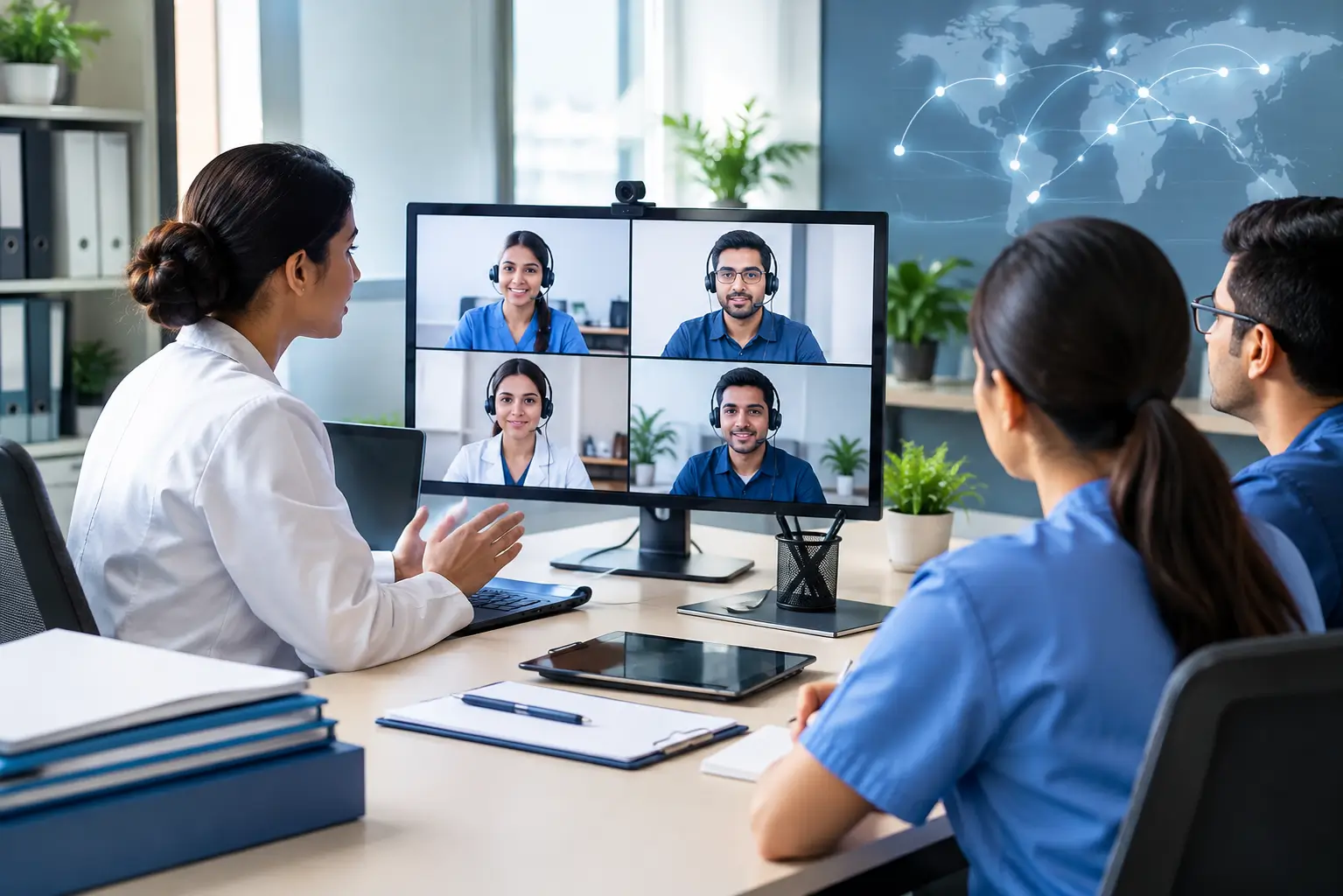
Offshore staffing gives healthcare organizations access to a much wider talent pool and allows them to build teams without being limited to candidates who happen to live near the practice.
It can also create more flexibility when a growing organization needs several people rather than one employee.
The Biggest Misunderstanding About Offshore Staffing
Lower payroll costs attract attention.
But cost alone doesn’t build a good team.
Hiring the least expensive person available and handing them a login is not a staffing strategy.
Healthcare work requires structure.
The employee needs to understand how the practice operates.
Who handles questions?
How are tasks assigned?
Which KPI matters?
What happens when something goes wrong?
Without clear answers, even talented people struggle.
Offshore Staffing vs Traditional In House Hiring
In house hiring gives healthcare organizations direct physical access to employees and may make day to day supervision easier. Offshore staffing provides access to a larger talent pool, easier scalability and potentially lower operating costs.
Neither one automatically produces better performance.
An experienced offshore billing specialist inside a strong process can outperform an inexperienced local employee.
An untrained remote worker inside a chaotic workflow can create significant problems.
The operating model matters more than the postcode.
What Usually Makes Offshore Healthcare Teams Fail?
The first problem is poor onboarding.
Organizations sometimes assume an experienced billing professional should immediately understand their workflow.
But every practice is different.
Payers differ.
Specialties differ.
Escalation rules differ.
Software differs.
A good onboarding process should cover both the technical work and how the organization expects that work to be performed.
The second problem is vague ownership.
“Follow up on claims” is not enough.
Which claims?
How often?
When should they be escalated?
How should outcomes be documented?
Specific expectations create consistency.
Communication is another common failure.
Remote employees shouldn’t need to chase managers for answers for three days.
Likewise, managers shouldn’t discover two weeks later that an entire work queue was blocked.
Data Security Cannot Be an Afterthought
Healthcare staffing also introduces a responsibility that ordinary outsourcing may not carry.
Protected health information.
Remote teams accessing healthcare systems need appropriate controls, permissions, training and contractual safeguards.
Organizations should understand how access is granted, what information staff can see and how credentials are managed when someone leaves.
A healthcare team should be designed around the minimum access required to perform its work.
Convenience isn’t worth compromising security.
Did You Know AI Is Changing Offshore Roles?
Automation will remove some repetitive work from healthcare operations.
That’s already happening.
But that doesn’t necessarily reduce the value of offshore staffing.
It changes the type of work people perform.
As revenue cycle automation becomes more capable, people can shift toward complex denials, payer communication, appeals, account research and performance analysis.
Healthcare leaders interviewed during 2026 have repeatedly emphasized that AI performs best when incorporated into established workflows rather than treated as a replacement for the workforce.
The best offshore employees of the next few years may therefore need stronger analytical and problem solving skills than traditional data processing roles required.
How to Build the Right Offshore Team
Start with one process.
Define it clearly.
Document the work.
Decide how success will be measured.
Then hire for that specific responsibility.
For medical billing, KPIs might include claim turnaround, accuracy and rejection rates.
For A/R, aging movement and account resolution may matter more.
For eligibility, accuracy and completion timelines could be key.
Whatever the role, performance should be visible.
Then create a communication rhythm.
Not constant meetings.
Just enough structure that the remote team and internal organization remain aligned.
Managed Offshore Staffing vs Hiring Freelancers
There’s also an important comparison here.
A freelancer may work well for a defined short term task.
Managed staffing is better suited to organizations that need people integrated into daily operations.
With managed staffing, recruiting, workforce administration and performance structures can be supported by an external partner.
That becomes particularly useful when an organization wants the benefits of offshore talent without building its own recruitment and workforce management operation overseas.
Sahar Technologies and Offshore Workforce Support
Sahar Technologies supports businesses with recruiting and offshore workforce management while also providing healthcare specific capabilities such as medical billing, RCM and administrative support.
That combination matters.
Healthcare organizations don’t just need someone who knows how to recruit.
They need people who understand the type of healthcare work being performed.
The objective is to build a team that feels less like an external resource and more like another part of the operation.
Final Thoughts
Offshore staffing isn’t a shortcut around workforce management.
It’s another workforce model.
Done properly, it can give healthcare organizations access to experienced people, additional capacity and greater operational flexibility.
Done poorly, it creates distance, confusion and rework.
Focus less on geography.
Focus more on recruitment, process, management and accountability.
That’s where successful offshore teams are built.
Frequently Asked Questions
- What is offshore healthcare staffing?
It involves healthcare organizations using remote employees or dedicated teams located in another country for eligible administrative, billing, RCM and other non clinical functions.
- Can offshore staff work on medical billing?
Yes. Trained offshore professionals can support billing, eligibility, claims, A/R and related workflows when appropriate compliance and security controls are in place.
- Is offshore staffing cheaper than U.S. hiring?
It can reduce workforce costs but organizations should evaluate management, technology, security and service quality alongside salary differences.
- What is the biggest reason offshore teams fail?
Poorly defined workflows, inadequate onboarding, weak communication and unclear accountability are common causes.
- Can Sahar Technologies recruit and manage offshore employees?
Yes. Sahar Technologies offers recruiting and offshore workforce support alongside healthcare billing and operational services.
If you have any questions regarding “offshore healthcare staffing”, feel free to contact us. For inquiries, call us at: +92 329 8263808.
Disclaimer: The above information is subject to change and represents the views of the author. It is shared for educational purposes only. Readers are advised to use their own judgment and seek specific professional advice before making any decisions. Sahar Technologies is not liable for any actions taken by readers based on the information shared in this article. You may consult with us before using this information for any purpose.